“Lots of parents don’t come specifically for the Montessori program but soon see the benefits of squeezing oranges and grinding coffee. There is an endgame, and it’s a seamless process.”
-Oak Meadow parent
Applications due Jan. 31

“Lots of parents don’t come specifically for the Montessori program but soon see the benefits of squeezing oranges and grinding coffee. There is an endgame, and it’s a seamless process.”
-Oak Meadow parent
Whether joining Oak Meadow as a 3–6 year-old, or continuing on from Oak Meadow’s Toddler program, students build critical foundations using task-oriented Montessori materials to explore language, order, movement, and refinement of the senses. To be eligible for this program, children must be 3 years old by September 1st of the year for which they are applying.
The classroom environment sparks curiosity and inspires self-motivation while supporting each child’s development of concentration, coordination, and independence. As children repeat their interaction with chosen materials, they interact with the materials in increasingly complex ways—taking on new challenges and processing deeper understanding. The three-year continuum (ages 3–6) assures continuity, individual pacing, and evolving social proficiency.
Montessori materials used in the Children’s House program promote curiosity, awaken the senses, and inspire self-motivation.
Explore the Children’s House Program curriculum below.
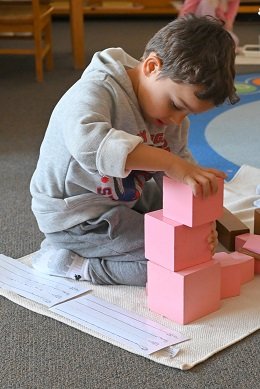
The use of engaging Montessori materials in the math program enables children to internalize the concepts of numbers, symbols, sequences, operations, patterns, and basic facts. The inviting and multi-sensory materials, carefully laid out from simple to complex, offer a concrete representation of abstract mathematical concepts such as simple operations, area, volume, and measurement. While children are learning addition and subtraction, the materials are reinforcing a rudimentary understanding of the decimal system. Children’s House students develop number fluency and apply their skills in meaningful ways. By the time they complete the Children’s House program, most students will have a solid understanding of numbers to 100 and many will grasp mathematical concepts far beyond.
The language curriculum is a sequential, systematic program designed for the acquisition of listening, speaking, reading, and writing. Using sandpaper letters, the moveable alphabet, metal insets, and other materials, children learn to recognize the shape and phonetic sounds of letters and the construction of words to develop skills in reading and writing. Children are exposed to rich literature and a wide assortment of reading materials to match their developmental stage. In doing so, they learn the joy of reading and the power of the written word. Wilson Fundations, a research-based sequential phonetic approach to learning language, complements the Montessori language curriculum.
The study of history, science and geography within the Children’s House cultural curriculum is designed to inspire a sense of awe in the child. In Children’s House, the study of physical geography begins with the use of materials such as sandpaper globes and puzzle maps, which give children a basic geographic understanding of the continents of the world, the countries within the continents, as well as the states of the United States. Through age-appropriate activities, experiments, and exploration, students are exposed to a rich curriculum of history and culture.
Children begin to understand the basic concepts of biology, chemistry, physics, and earth sciences through hands-on exploration and experimentation. The Children’s House science curriculum is expansive and includes the study of vertebrates and invertebrates, identifying the parts of a plant or tree, and understanding the difference between a liquid, solid, and a gas. Student interest will drive project-based exploration such as sprouting seeds to learn about roots, stems, and leaves, or building a circuit using a battery.
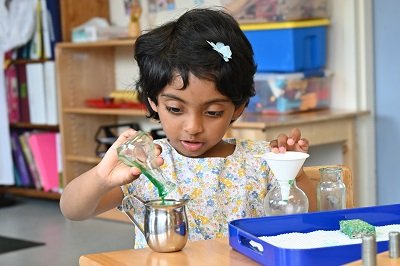
This area of study most intrigues this age of students who want to acquire the life skills that they observe in the adult world. Children prepare food, polish objects, use a broom, cut and arrange flowers. They master personal care, learning to button, tie, zip and snap. Children choose their work and complete a specific sequence of steps for a task. This appeals to the young child’s innate sense of order. Practical life work cultivates independence and builds students’ self-esteem as they become confident in their abilities. Children learn to concentrate and focus on the materials, laying the foundation for all other classroom work. Excitement for new-found abilities encourages a desire for more challenges.
Children discover the physical world around them through their senses. Montessori sensorial materials help students develop powers of focus and observation. Students learn to order, classify, and describe sensory impressions of length, width, height, temperature, mass, color, scent, taste, touch, and pitch. The materials create an awareness of variations, such as the wide spectrum of color in nature, the broad range of sound, the feel of rough and smooth, heavy and light, warm and cold. Students come to distinguish, categorize, and relate new information to information they have already acquired, skills critical to the development of judgment and decision making. This area of study results in the acquisition of new vocabulary, as well as the expansion of the language of description (color, size, texture, sound, etc.) and comparative language (e.g. small, smaller, smallest).
Social and emotional learning includes self-awareness, self-management, social awareness, responsible decision-making, and relationship skills. By developing these skills and promoting prosocial behavior, we strive to create learning environments where students feel safe, valued, and connected. Children’s House students explore developmentally appropriate concepts of social and emotional learning. Topics may include personal greetings, personal space, friendship, conflict resolution, feelings, coping skills, and self-control. Lessons are taught through hands-on activities, themed stories, visual cues, role-playing, and guided discussions.
Lessons in grace and courtesy are intermingled with academics and are presented with equal importance. Children’s House students are taught to behave with grace and courtesy, the foundation of conduct at Oak Meadow. In the resulting environment of peace and safety, students are able to calmly concentrate and move toward greater self-confidence and independence.
In Children’s House, students learn conflict resolution as a way of achieving peace within the classroom. Cooperative living is put into practice as students complete daily chores with the common goal of keeping their classroom neat and tidy. The concept is extended to the world outside when these young students participate in caring for their planet. Children’s House classes host guests who awaken awareness of differences, as the school promotes acceptance. Students learn philosophies of peace when they study the lives of historical peacemakers. Oak Meadow hopes that each graduate of the school will exemplify this fundamental Montessori practice along every path followed.
Kindergarten STEAM invites children to explore science, technology, engineering, art, and math through hands-on discovery and playful experimentation. Guided by the scientific method, students learn to form hypotheses, record observations, and learn to meet failed experiments with curiosity rather than frustration. Activities such as exploring surface tension, mixing colors, and growing seeds help children to understand cause and effect. During a multi-week engineering project, students design and build outdoor animal homes, testing and rethinking materials and structures in response to weather, stability, and function. Environmental science is woven throughout the curriculum as children learn to identify native and invasive species and explore edible and non-edible plants. The class has also adopted a small wooded area on campus, nicknamed “The Wild”, which serves as an outdoor classroom where curiosity leads learning. As students explore decomposers and natural systems, they build problem-solving skills, creativity, and confidence, laying a strong foundation for lifelong learning.
Art in the Children’s House is a hands-on, process-centered experience that reflects Montessori values of independence, exploration, and joyful learning. Children are invited to engage with materials as tools for discovery, emphasizing curiosity and creative thinking over a finished product. In the first and second year, children explore foundational elements of art including line, color, texture, and form through experiences such as printmaking, collage, watercolor, sculpture, and mixed-media work. These activities support fine motor development while encouraging children to test ideas, solve problems, and build confidence through repetition and choice. In the third year, children deepen their artistic practice through purposeful drawing, observational studies, and artist-inspired projects that foster focus, intention, and compositional awareness. Children learn to care for materials, make thoughtful choices, and express ideas visually. Whether working independently or collaboratively, students develop confidence, creativity, and a strong sense of themselves as imaginative, capable artists connected to their world.
The Children’s House Music & Drama curriculum emphasizes group singing and movement, rhythmic training, individual confidence, and imaginative play. Classes incorporate songs and dances from cultural traditions worldwide. Through solfège singing and rhythmic games, students gain confidence to sing alone in front of others and to read and write simple rhythms. Musical instruments from around the world are introduced in hands-on lessons, which include discussion of instrument materials and how sound is produced. Students enjoy performing and song-leading at school assemblies on occasion. In the Spring Term, Children’s House classes participate in Storybook Theatre, a Drama unit in which we rehearse and perform beloved picture books, including such classics as Where the Wild Things Are, Caps for Sale, The Trouble with Trolls, and The Mitten.
Nature learning in the Children’s House invites children to explore the outdoors through play-based experiential learning. Throughout the year, children engage in seasonal studies that deepen their understanding of plants, animals, and natural systems. Gardening experiences introduce seeds, roots, stems, and healthy growth as children plant seeds and care for the school garden. Forestry studies focus on the parts of trees and the role roots play in stability and nourishment, while early comparisons of native and invasive species build ecological awareness. In ornithology, children become young birders, learning to identify common birds by sight and sound while exploring migration and nesting habits outdoors. Entomology studies guide children in gently handling insects, fostering respect and curiosity while discovering that even the creepiest crawlies are far less frightening than they first appear. Nature work also supports practical life and motor development as children use garden tools, handle insects with care, and explore nature. Through joyful outdoor exploration, children develop curiosity, independence, and a lasting connection to the natural world.
Children’s House Physical Education supports the development of coordination, confidence, and a joyful relationship with movement. Each class follows a predictable routine that helps children feel comfortable and ready to participate, beginning with a group gathering and warm-up activities. Through imaginative movement such as animal walks, obstacle paths, and playful games, children build fundamental gross motor skills including running, jumping, hopping, skipping, balancing, and climbing. Activities with balls, bean bags, and targets strengthen hand-eye coordination and body control, while group games encourage cooperation, turn-taking, and positive communication. Children also develop spatial awareness as they learn to move safely over, under, around, and through their environment. Classes conclude with calming activities such as breathing exercises or yoga stories, supporting self-regulation and smooth transitions. Throughout the program, emphasis is placed on joyful participation, grace and courtesy, and whole-child development, helping children grow in confidence, coordination, and a sense of belonging through movement.
Children’s House Spanish introduces language in a joyful, natural way through songs, stories, movement, and play. Using a Comprehensible Input approach, children are immersed in clear, meaningful Spanish that connects to their everyday experiences. Each class follows familiar routines, greeting one another and naming the day, weather, and season, which helps children feel confident and comfortable using Spanish as part of their daily rhythm. Through interactive games, storytelling, and music, children explore vocabulary related to classroom life, emotions, numbers, colors, family, animals, food, and the natural world. Stories and songs invite listening, repetition, gestures, and active participation at each child’s own pace. Movement-based activities support comprehension while encouraging joyful collaboration. Over time, children develop strong listening skills, recognize familiar words, follow simple instructions, and begin expressing themselves in Spanish, building a foundation rooted in curiosity, connection, and delight.





Oak Meadow Montessori School admits qualified students of any race, color, national or ethnic origin, ancestry, sex, religion, mental or physical disability, genetic information, gender identity or sexual orientation to all the rights, privileges, programs, and activities generally accorded or made available to students at the School. The School does not discriminate on the basis of race, color, national or ethnic origin, ancestry, sex, religion, mental or physical disability, genetic information, gender identity or sexual orientation, or any other status protected by applicable law in the administration of its educational, admissions, financial aid, athletic and other policies and programs.
© 2026 Oak Meadow Montessori School. Privacy Policy | Cookie PolicyEnvision Marketing & Design